
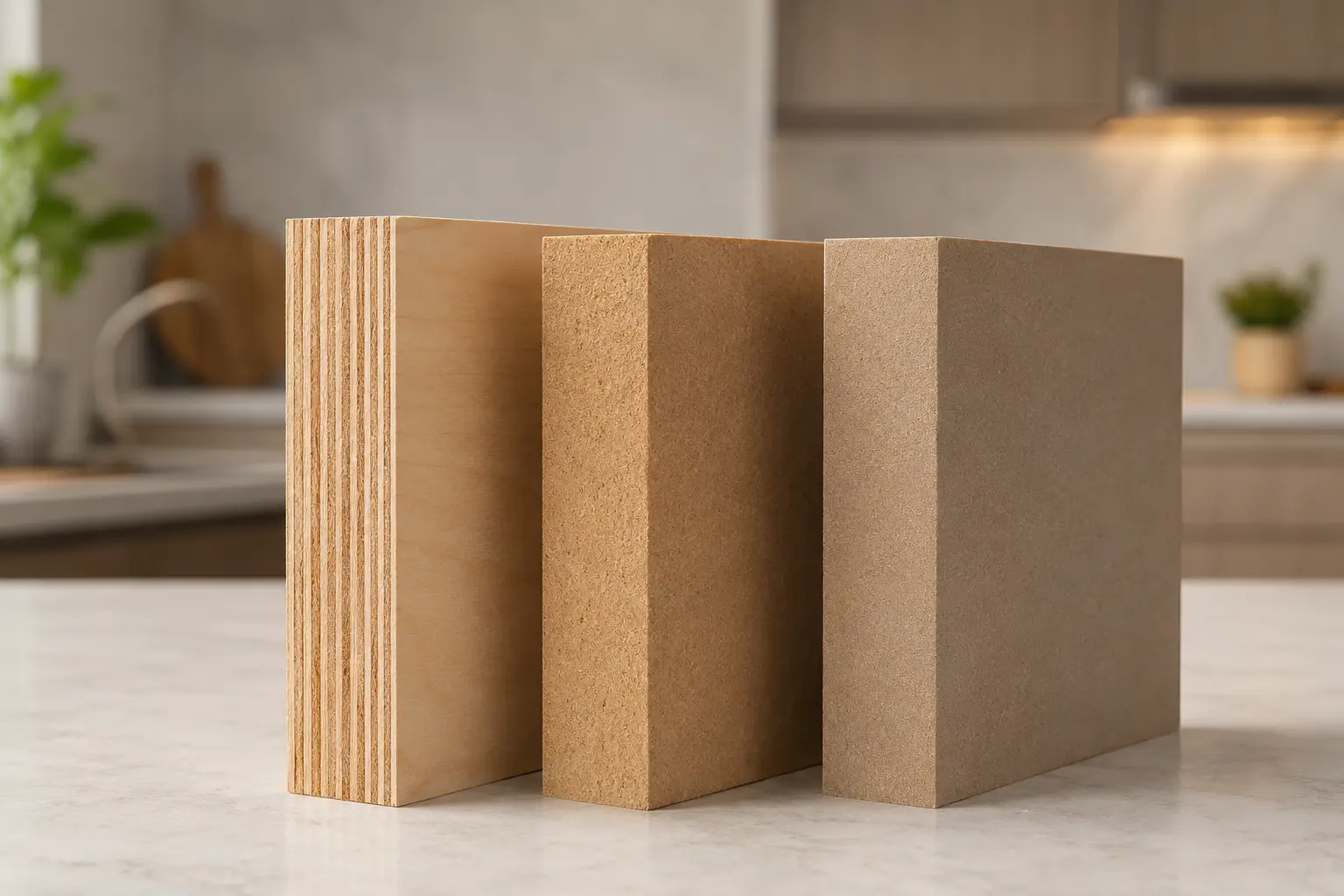
Which board lasts longer, plywood, MDF or HDHMR?
Quality plywood usually gives the strongest, longest-lasting cabinets due to its cross-layer build. HDHMR comes close, with better moisture resistance than standard MDF at a lower cost. MDF works best for painted, dry, decorative spots, not daily heavy use.
If you are planning a modular kitchen, this comparison is probably the first question on your mind. Picking between plywood vs MDF vs HDHMR feels confusing because every dealer has a different opinion, and every board looks the same once laminated. The real answer depends on where the board sits, how thick it is, and how well it is installed, not just the name on the sheet. This guide breaks down each material in plain words, so you can choose the right board for each part of your kitchen.
Plywood vs MDF vs HDHMR: Quick Comparison
Here is a quick side-by-side look at plywood vs MDF vs HDHMR before we go into detail. Keep this table handy while talking to your contractor.
| Feature | Plywood | MDF | HDHMR |
| Structural strength | High | Moderate | High |
| Moisture resistance | Depends on grade | Lower in standard boards | Better than standard MDF |
| Screw holding | Strong | Moderate | Strong |
| Surface finish | Good | Excellent | Very good |
| Heavy-use suitability | Excellent | Select uses only | Very good |
| Cost | Generally higher | Generally lower | Mid-range |
| Best suited for | Cabinet carcass, heavy use | Painted, decorative shutters | Moisture-prone, versatile spots |
No single board wins every category. That is why smart kitchen planning often mixes materials instead of using just one.
Why Plywood Continues to Be a Durable Choice for Interiors
Plywood is made by gluing thin wood sheets, called veneers, one on top of another, each layer at a right angle to the one below. This cross-lamination gives plywood its strength, its resistance to warping, and its firm grip on screws.
In India, plywood is graded by the Bureau of Indian Standards (BIS). IS 303 covers MR and BWR grades for regular furniture and semi-humid spots. IS 710 covers marine-grade BWP plywood, built for long water exposure.
If you want a closer look at BWP 710 and BWR 303 grade plywood, see our detailed guide on these plywood options.
● MR plywood – best used where regular water exposure is unlikely
● BWR plywood – safer for carcasses that face daily moisture
● Marine plywood – the strongest option, useful near sinks or in humid regions
REPLACE THE ABOVE RED MARKED TEXT WITH THE FOLLOWING GREEN TEXT
● MR plywood – best used where regular water exposure is unlikely
● BWR plywood – safer for carcasses that face daily moisture
● BWP Marine plywood – the strongest option, useful near sinks or in humid regions
( MR=Moisture Resistant , BWR=Boiling Water Resistant and BWP=Boiling Water Proof)
The right grade depends on how much moisture that cabinet faces, not on buying the costliest sheet for the whole kitchen.
Liva Interiors Field Note: A Note from Liva: We pick the plywood grade cabinet by cabinet. A sink base gets a higher moisture-resistant grade, while a tall pantry unit away from water works fine with a standard grade.
What Is MDF and Is It Good for Kitchen Cabinets?
MDF, or Medium-Density Fibreboard, is made from fine wood fibres pressed together with resin. It has no visible layers, giving it a smooth, uniform surface ideal for paint finishes and detailed router designs.
The trade-off is moisture. Standard MDF absorbs water faster than plywood or HDHMR, and repeated wetting swells its edges. Is MDF good for kitchen cabinets? It works well for painted shutters and dry areas, but not for spots that get wet often, like sink cabinets.
MDF makes the most sense for:
● Painted shutters with a smooth finish
● Decorative panels and false fronts
● Interior fittings away from splashes
What Is HDHMR and Is It Better Than Plywood?
HDHMR stands for High-Density High Moisture Resistant board, an upgraded version of MDF pressed to a higher density and treated to handle moisture better.
This denser build gives HDHMR a firm grip on screws, better resistance to swelling than standard MDF, and a smooth surface for paint, laminate or veneer.
| Point | HDHMR | Plywood |
| Density | Higher | Varies by grade |
| Moisture resistance | Strong, engineered | Strong in BWR/BWP grades |
| Weight | Heavier | Lighter for same thickness |
| Finish | Very smooth | Needs veneer or laminate |
| Cost | Mid-range | Generally higher |
Is HDHMR better than plywood? HDHMR is a strong alternative to plywood, but the better choice depends on the application, board thickness, moisture exposure, and how well it is installed. Neither wins in every kitchen.
Which Material Handles Moisture Best?
Kitchens deal with steam, spills and sink splashes daily, so moisture resistance matters more here than anywhere else in the home.
● Plywood – BWR and marine grades handle moisture well; exposed edges still need sealing.
● MDF – standard boards are most vulnerable to water; moisture-resistant variants exist but are not waterproof.
● HDHMR – built for better moisture resistance than standard MDF, though it still needs proper edge banding.
For a moisture-prone kitchen, suitable BWR or marine plywood(BWP) and quality HDHMR both perform well.
Which Material Is Best for Kitchen Carcasses vs Shutters?
Most homeowners assume one board must cover the whole kitchen. Modular kitchen cabinets can instead use different materials for different parts, choosing the right board for each application.
| Kitchen Part | Suitable Material | Main Reason |
| Base cabinet carcass | Plywood / HDHMR | Daily strength and load |
| Sink cabinet | BWR/marine plywood or HDHMR | Constant moisture exposure |
| Painted shutters | MDF / HDHMR | Smooth paint finish |
| Heavy-load storage | Plywood | Strong screw holding |
| Decorative panels | MDF / HDHMR | Design flexibility |
Splitting materials this way often gives a stronger, better-value kitchen than forcing one board type everywhere.
What Actually Determines Kitchen Cabinet Durability?
A durable board alone does not guarantee a long-lasting kitchen cabinet. A premium board can still fail early if the rest of the build is weak. Cabinet life depends on:
- Board quality and grade
- Board thickness
- Moisture exposure
- Edge sealing
- Surface finish (laminate, veneer, paint)
- Hardware quality (hinges, drawer channels)
- Installation and workmanship
A high-grade board with cheap hinges or poor edge sealing wears out faster than a mid-range board installed with care.
Is More Expensive Cabinet Material Always Better?
Not always. The initial price is only part of the cost; durability and service life also matter. Value depends on moisture resistance, hardware life, and repair frequency, what professionals call total cost of ownership. A mid-priced HDHMR cabinet with good hardware can outlast a costly board that was poorly fitted.
Which Kitchen Cabinet Material Offers the Best Long-Term Durability?
This is the core question behind the comparison, and the answer shifts slightly by use case.
| Requirement | Recommended Option |
| Maximum structural strength | Quality plywood |
| Heavy daily use | Quality plywood |
| Moisture-prone area | BWR/marine plywood or HDHMR |
| Painted shutters | MDF or HDHMR |
| Balance of cost and performance | HDHMR |
If long-term strength is the priority, quality plywood is generally the most durable kitchen cabinet material overall. A correctly specified HDHMR cabinet is a practical, budget-friendly alternative, while MDF stays useful for painted or decorative parts. A well-installed cabinet in the right material almost always outlasts a poorly installed “premium” one.
What About Formaldehyde and Indoor Air Quality?
Engineered wood boards, including plywood, MDF and HDHMR, use resin-based adhesives. Buyers can check the formaldehyde-emission rating, such as E1, on the product’s technical sheet before purchase, since closed kitchen spaces make indoor air quality worth confirming with the manufacturer.
How to Make Kitchen Cabinets Last Longer
● Wipe standing water off counters and edges quickly
● Seal or protect exposed board edges
● Fix plumbing leaks near the sink cabinet right away
● Avoid overloading shelves beyond their limit
● Clean and oil hinges and drawer channels now and then
● Check sink-area cabinets every few months for swelling
Which Material Should You Choose for Different Kitchen Areas?
● Choose plywood if you want maximum strength and expect heavy daily use.
● Choose HDHMR if you want a balance of performance, cost and moisture resistance.
● Choose MDF if a painted finish matters most and the spot stays dry.
FAQs
Which lasts longer, plywood or MDF?
Quality plywood generally lasts longer, due to its cross-layer strength and better moisture handling in BWR and marine grades.
Is plywood stronger than HDHMR?
Both are strong, but plywood usually has a slight edge in raw strength, while HDHMR offers a smoother finish.
Is HDHMR better than MDF for kitchens?
Yes, HDHMR is denser and more moisture-resistant than standard MDF.
Is HDHMR waterproof?
No. HDHMR is moisture-resistant, not waterproof. Long standing water can still damage it without sealed edges.
Can MDF be used for kitchen cabinets?
Yes, mainly for painted shutters and decorative panels kept away from constant water.
Which material is best for the sink cabinet?
BWR or marine-grade plywood and quality HDHMR both handle sink-area moisture well with sealed edges.
Is plywood worth the extra cost?
For heavy-use carcasses and load-bearing units, plywood’s strength often justifies the higher price over time.
What is the most durable kitchen cabinet material?
Quality plywood is generally the most durable kitchen cabinet material for structural strength, with HDHMR as a budget-friendly alternative.
Can you use different materials in the same kitchen?
Yes, many kitchens combine plywood, MDF and HDHMR, choosing each board by what that cabinet needs.
Final Verdict: Plywood vs MDF vs HDHMR
There is no single winner in the plywood vs MDF vs HDHMR debate. Quality plywood stays the strongest all-round choice for maximum durability. HDHMR gives a solid mix of strength, moisture resistance and cost for many parts of the kitchen. MDF stays useful for painted and decorative shutters where moisture is not a daily concern. For homeowners planning a complete interior project, Liva Interiors combines material selection, modular kitchen design, manufacturing and installation under one roof.