
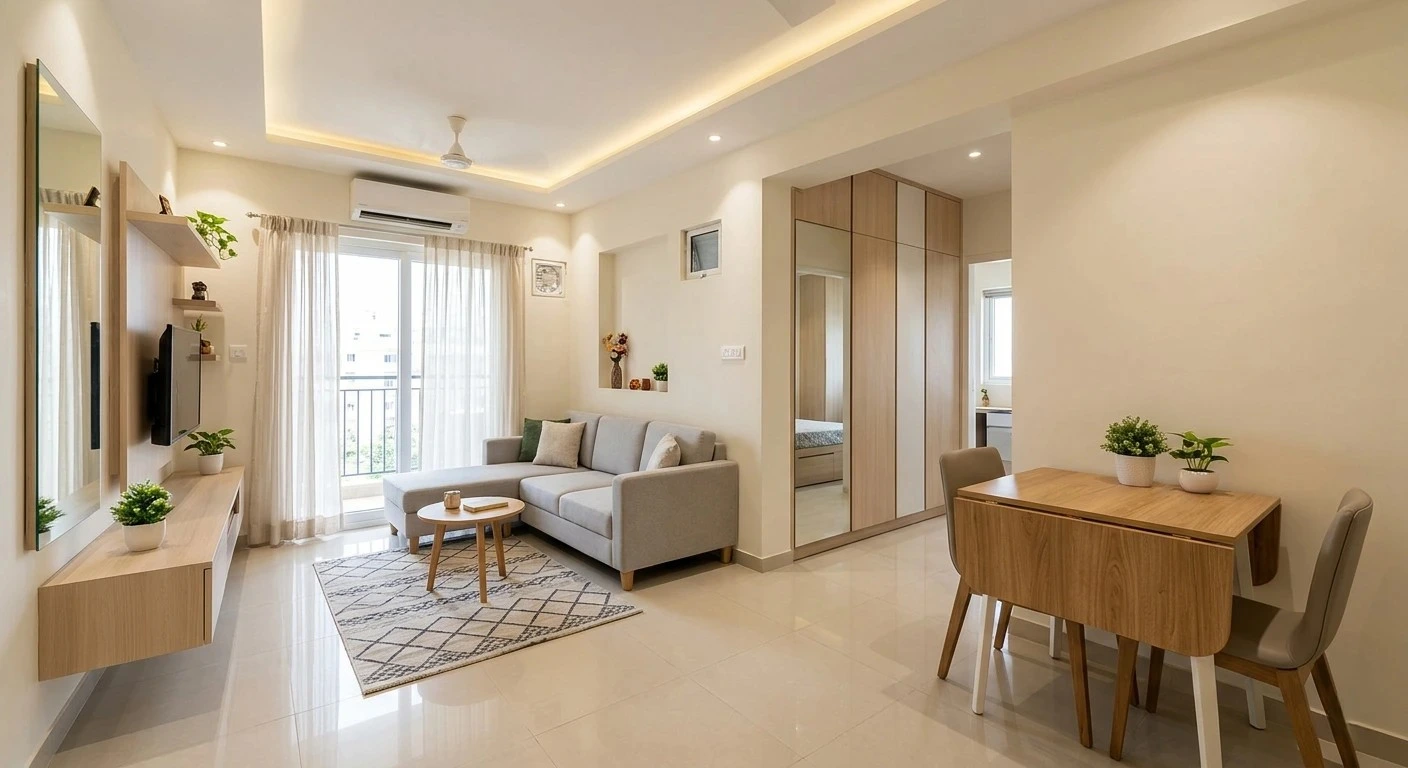
You spent months imagining how your home would feel once everything came together. Every material was chosen carefully. Every corner was planned with excitement. And when the interiors were finally complete, you expected to walk into a space that felt warm, open, and truly yours.
But it did not feel that way.
The living room felt closed. The bedroom felt tight. That hallway you walked through a hundred times during construction suddenly felt like a narrow corridor. The tiles were perfect, the paint was clean – but the home just did not feel like home.
This is one of the toughest and most emotional situations homeowners face during the construction journey. And the answer almost always comes back to the same root cause: the right interior design tips for small spaces were never part of the plan.
It was never about the carpet area. It was really about creating a space that felt comfortable and practical for everyday living.
The Difference Between Owning Space and Actually Living In It
Carpet area is a number on a document. Livable space is what you feel the moment you step inside. These two things can be very far apart – and most homeowners only discover that gap after the interiors are done.
A 900 sq. ft. 2BHK with poor layout decisions can feel like 600 sq. ft. every single day. That invisible shrinkage is not accidental. It is the result of specific choices made during planning.
Why the Eye Decides How Big a Room Feels
Your brain does not measure rooms with a tape. It reads sightlines – how far the eye can travel before hitting a wall, a cabinet, or a piece of furniture. When those sightlines are blocked, the room registers as small.
Interior layout planning works on this principle. When furniture is scaled correctly and movement areas stay visually open, a room naturally feels more spacious than its actual square footage. Cluttered sightlines do the opposite – regardless of the actual square footage.
What Actually Makes a 2BHK Feel Cramped After Interiors
These are not random problems. They follow a pattern – and once you see it, you cannot unsee it.
Furniture That Was Never the Right Size for the Room
Here is what happens in almost every case. The homeowner visits a furniture showroom, falls in love with a large sectional sofa, and pictures it in the living room. It looked amazing in the showroom. In the actual 2BHK, it leaves 18 inches of walking space on either side.
The ideal circulation width is 36 inches. Drop below that and the room will feel tight every day – no matter how beautiful the fabric is.
Modular seating, compact 3-seater sofas, and nesting tables fit the room without swallowing it. Furniture is meant to support the space, not dominate it.
Smart Living Room Interior Design in India focuses on circulation space, furniture proportion, and visual openness instead of simply filling the room with larger pieces.
Storage That Solved Nothing and Added Visual Chaos
Lofts above every door. A TV unit built wall to wall, packed with shelves and profiles on both sides. Overhead cabinets in every corner. Each of these felt like smart storage during planning. Together, they create a room that feels visually cluttered even when it is technically clean.
Over-designed storage reduces breathing space – both physical and visual. Space saving interior design ideas like hydraulic beds, wall niches, and flush floor-to-ceiling wardrobes store just as much while keeping the room visually calm.
A Wardrobe That Took Too Much From the Bedroom
The ideal wardrobe depth is 24 inches. In many Kerala apartments, bedroom widths are already modest. When wardrobes push past that depth, the clearance beside the bed drops below 30 inches – and the bedroom begins to feel like a corridor you sleep in.
Sliding wardrobes with mirror panels are a straightforward fix. They need no swing space, reflect light back into the room, and rank among the most practical space saving interior design ideas for compact bedrooms. One decision – noticeably different room.
Dark Finishes That Made the Room Feel Heavier
Dark teak finishes and matte black laminates have their place. That place is not a compact apartment interior design with limited natural light. These finishes absorb light. They pull walls closer. They make ceilings feel lower.
Warm white LED lighting, acrylic panels, and reflective laminates work in the opposite direction – they distribute light, add visual depth, and make the room feel more open without changing a single dimension.
A False Ceiling That Nobody Needed
Layered false ceiling work belongs in homes where the slab sits well above 11 feet – not in a standard 2BHK. When your slab sits at 10 ft and the false ceiling drops another 8 inches or more, every room starts feeling lower and heavier than it actually is.
Simple cove lighting or recessed profiles give the same layered effect – without the weight.
Furniture Placement That Nobody Thought Through
A dining area only feels comfortable when chairs have enough space to slide back and people can move around without obstruction. When that space is missing, every meal involves pushing furniture aside to sit down. Apartment circulation planning means thinking about how people actually move through a room – not just how furniture looks inside it on a floor plan.
What Designers Do That Changes Everything
The difference between a home that feels open and one that feels tight is rarely the budget. It is almost always the process.
They Plan Movement Before They Choose Anything Else
Before a single finish is selected, professional designers map how people will move through the space. They use anthropometric standards – real measurements of how human bodies move, sit, reach, and turn – to decide furniture placement, clearance widths, and zone boundaries.
This is not decoration. This is ergonomic planning, and it is the step most homeowners never know exists.
They Protect Empty Space on Purpose
The most consistent pattern in well-designed compact homes is intentional emptiness. Negative space – wall area, floor area, visual gaps between furniture – is not wasted space. It is the space that makes everything else feel right.
This is the core principle behind minimalist apartment interiors. Not less furniture because of a design trend. Less furniture because breathing room is the actual product.
They Remove Visual Noise Wherever They Can
Handleless shutters. Flush cabinetry. Seamless laminates. Recessed handles. Every one of these decisions removes a visual line from the room. Fewer lines mean a calmer surface. A calmer surface means a more open feel.
Functional interior design is built on what you take away – not what you add.
Space Saving Interior Design Ideas That Work in Real Apartments
Not showrooms. Not Instagram. Real 2BHK apartments with standard room widths and normal slab heights.
Furniture That Does More Than One Thing
A Murphy bed returns the entire floor to you during the day. A foldable dining table gives you four seats when you need them and open floor space when you do not. A storage ottoman holds things and doubles as a surface. These are small apartment layout ideas that change how a home feels – every single morning.
Storage That Goes Up, Not Out
Floor space runs out fast. Wall space rarely gets used properly. Floating shelves, tall cabinetry, and wall niches push storage upward – keeping the floor clear and the room breathable. One of the most reliable interior design tips for small spaces is simply to stop treating walls as blank backgrounds.
The Same Floor Tile, Used Everywhere
One continuous vitrified tile across the living room, dining area, and kitchen removes the visual breaks between zones. Seamless flooring allows the eye to travel further without stopping. The apartment measures the same – but it reads as larger.
What We See Repeatedly in Kerala 2BHK Apartments
Across projects in Kochi and Calicut, the same patterns show up without fail:
● Lofts above every opening, cutting into ceiling breathing space
● Dark teak finishes in rooms that already get limited light
● Oversized dining sets with no pull-back clearance built into the plan
● TV walls with heavy profiles that dominate the living room
● Balcony openings partially blocked by cabinetry, cutting off natural light
Individually, each of these feels like a reasonable decision. Together, they consistently turn a well-sized apartment into a space that feels too small to live comfortably in.
Conclusion
The apartments that feel genuinely open – the ones where you walk in and immediately relax – were not designed that way by accident. They were built around movement, light, proportion, and the confidence to leave some space alone.
Working with an experienced Interior Designing Company in India can help homeowners avoid these space planning mistakes before execution begins.
Interior design tips for small spaces only deliver results when they are part of the plan from day one. Not applied as corrections after the wardrobes are installed and the false ceiling is done.
At Liva Interiors, the first question we ask about any project is simple: how will this space feel to live in? Everything else follows from there.
FAQ
Why does a 2BHK feel smaller after interiors are done?
Oversized furniture, deep wardrobes, excessive storage, dark finishes, and poor circulation planning reduce movement space and block light. The result is an apartment that feels noticeably smaller than its actual carpet area.
What is the right wardrobe depth for a small bedroom?
24 inches. Deeper wardrobes eat into the 30–36 inch clearance needed beside the bed – and the bedroom begins to feel like a passage.
Do false ceilings make compact apartments feel smaller?
Yes, when the drop exceeds 6–8 inches. Cove lighting and recessed profiles are a better fit for standard slab heights in most 2BHK apartments.
Are sliding wardrobes worth it in compact bedrooms?
Yes. They save swing space, reflect light, and are among the most reliable interior design tips for small spaces when bedroom widths are limited.
Is modular furniture a good choice for 2BHK apartments?
Absolutely. Modular pieces scale to room size, adapt over time, and make for genuinely effective space saving interior design ideas