
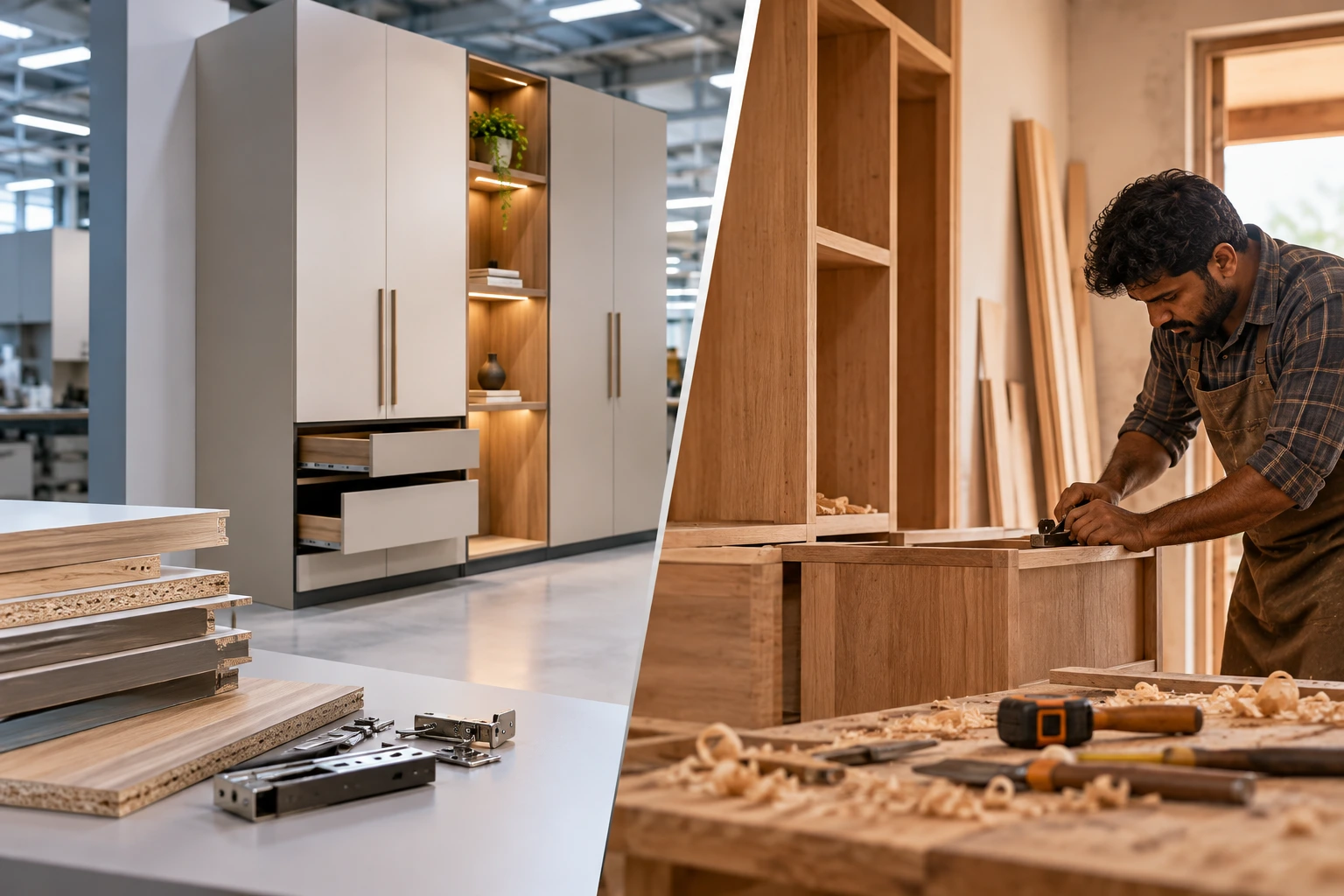
How Factory-Made Modular Furniture Is Different from Carpenter Made Furniture.
Choosing between factory-made modular furniture and carpenter made furniture is one of the biggest decisions in home interior planning. Modular furniture vs carpenter made furniture is not about which one is better in general. It is about which one fits your space, budget and timeline.
Here is the short answer: Factory made modular furniture is built in a controlled factory using standard measurements and machines. Carpenter made furniture is built and finished on-site, based on your home’s exact space and needs.
Both styles have real strengths. Several practical factors set factory-made modular furniture apart from furniture built by a carpenter, including how it is manufactured, finished, installed, and customized:
- Manufacturing process
- Precision and finish
- Customization
- Material consistency
- Installation timeline
- Cost and value
- After-sales support
This guide breaks down each factor in plain words, so you can pick what actually works for your home.
What Is Factory-Made Modular Furniture?
Factory-made modular furniture is furniture built in a dedicated factory, not at your home. Each piece is made from parts, or modules, that fit together like building blocks.This approach is also used in custom-made modular interiors, where modules are designed around the requirements of a specific home.
Here is how it works:
- Components are cut and shaped using CNC machines and precision tools.
- Edge banding and finishing happen in a controlled indoor setting.
- Every panel follows a fixed design and measurement.
- Finished modules travel to your home for final assembly.
How Factory-Made Modular Furniture Is Manufactured
The process follows a fixed sequence: Design, Measurement, Material selection, Machine cutting, Edge banding, Finishing, Quality checking, Delivery, Installation. Each step happens away from your home, so the mess stays at the factory.
What Is Carpenter-Made Furniture?
Carpenter-made furniture is built the traditional way. A carpenter visits your home, takes measurements, and builds the furniture to match your exact space.
Key points about this method:
- Cutting, assembly and finishing may happen at your home or a nearby workshop.
- You can request design changes while the work is in progress.
- Quality depends on the carpenter’s skill, tools and working conditions.
How Carpenter-Made Furniture Is Built
The steps here are: Measurement, Material purchase, Cutting, Assembly, Installation, Finishing. Carpenter-made does not mean lower quality. A skilled carpenter using good plywood or MDF can build furniture that lasts for years. The materials and workmanship decide the outcome, not the label.
Modular Furniture vs Carpenter-Made Furniture: Key Differences
Comparing modular furniture vs carpenter-made furniture side by side makes the choice much clearer. Below is a simple table showing where each option stands.
| Factor | Factory-Made Modular Furniture | Carpenter-Made Furniture |
| Manufacturing | Factory-controlled production | Mostly on-site or workshop production |
| Precision | Machine-assisted precision | Depends on workmanship |
| Customization | Customizable within modular systems | Highly flexible on-site |
| Finish | Consistent factory finish | Varies by application |
| Installation | Pre-made modules assembled on-site | Built and assembled step by step |
| Timeline | Usually predictable | Can vary with site conditions |
| Waste | Better-controlled material usage | Can create more on-site waste |
| Quality consistency | Standardized process | Varies by carpenter and materials |
| Repairs | Individual modules easier to replace | Repairs need on-site carpentry |
Manufacturing and Precision
Factory production relies on CNC machines and fixed measurements, so each cut stays accurate. Carpenter-made furniture depends on manual skill, which can vary from one project to the next.
Customization and Design Flexibility
Carpenter-made furniture allows big changes even mid-project, since a carpenter can adjust the plan on-site. Modular furniture also allows customization through module sizes, finishes, layouts and accessories, but it works inside a manufacturing system with set options.
Quality and Finish
Quality checks in a factory cover edge finishing, hardware fitting and material grade before the modules leave the plant. The material itself also matters. Plywood, MDF and HDHMR have different strengths and applications, so the right board should be selected based on where and how the furniture will be used. A carpenter’s finish quality depends on tools, workspace and experience. Neither method guarantees a better result on its own. The materials, hardware and workmanship used matter more than the label.
Installation and Timeline
Factory production happens before the installation day, so site work reduces to assembly. Carpenter-made furniture involves cutting, building and finishing happening at your home, which usually takes more days.
Modular Furniture Benefits
Understanding modular furniture benefits helps you see where this option shines the most. It is not just about looks. It is about process and predictability.
- Consistent manufacturing across every module
- Precision and repeatability using CNC tools
- Controlled, dust-free finishing
- Faster and more predictable installation
- Less mess and disruption at your home
- Systematic quality checks before delivery
- Better coordination between design, factory and installation team
- Easier replacement of a single damaged module
These advantages are particularly useful in spaces that require coordinated storage, hardware and installation, such as a modular kitchen. The real outcome still depends on the materials, hardware brand, manufacturer and installation team. A modular system with weak hardware will not outperform well-built carpenter furniture.
Carpenter Furniture Benefits
Looking at carpenter furniture benefits, the biggest strength is flexibility. A carpenter can shape furniture around your exact space, even the tricky corners.
- High flexibility for unusual or irregular spaces
- Easy on-site modifications during the build
- Suited for highly custom dimensions
- Works well for one-off, single furniture pieces
- Direct communication with the carpenter for quick changes
- A practical fit where standard modular sizes do not work
Just like modular furniture, the final quality relies on the plywood, laminate, hinges and drawer channels used, along with the carpenter’s skill.
Which Is Better: Modular Furniture or Carpenter-Made Furniture?
There is no single winner in modular furniture vs carpenter-made furniture. The right pick depends on your priorities.
Choose factory-made modular furniture if you want:
- Predictable production and delivery
- Consistent finish across every unit
- Machine-level precision
- An organized installation day
- Reduced site work at home
- Standardized quality checks
Choose carpenter-made furniture if you want:
- Maximum flexibility for unusual spaces
- Frequent design changes during the build
- Highly bespoke, one-of-a-kind furniture
The better choice depends on your space, design needs, budget, timeline and the finish quality you expect. Weighing both modular furniture benefits and carpenter furniture benefits against your own priorities gives you the clearest answer.
What Should You Check Before Choosing?
A short checklist saves you from costly mistakes later, no matter which option you pick.
For modular furniture, check:
- Board and material specifications (plywood, MDF, HDF)
- Hardware brand and quality (hinges, drawer channels)
- Edge-banding quality
- Manufacturing standards
- Warranty terms
- Measurement and installation process
- After-sales service
If you are planning a complete home interior project, it is also important to evaluate the company handling the design, manufacturing, installation and after-sales support. Our guide on choosing an interior design company covers the key factors to check before starting a project.
For carpenter-made furniture, check:
- The carpenter’s previous work
- Material specifications used
- Hardware quality
- Workmanship and finishing method
- Project timeline
- A written quotation
- Warranty or repair terms
FAQs
Is modular furniture better than carpenter-made furniture?
Neither is automatically better. Modular furniture offers precision and faster installation. Carpenter-made furniture offers more on-site flexibility. Your priorities decide the winner.
Is carpenter-made furniture cheaper than modular furniture?
Not always. Price depends on materials, hardware, design complexity, workmanship and the size of the project.
Is modular furniture durable?
Durability depends on board quality, hardware grade, construction method and installation. Good materials make modular furniture last for years.
Can modular furniture be customized?
Yes. You can customize dimensions, layouts, finishes, storage and accessories, though the options work within the manufacturer’s system.
What is the main difference between modular and carpenter-made furniture?
Modular furniture is built in a factory with machines and standard designs. Carpenter-made furniture is built on-site by hand, matched to your exact space.
Conclusion
Factory-made modular furniture .Before you decide, compare modular furniture benefits and carpenter furniture benefits side by side, not just the price tag. Look past the label, check the materials and hardware, and pick what fits your home and your life best. Look past the label, check the materials and hardware, and choose the approach that fits your home and your needs. If you are planning a complete home interior project, explore home interiors in India by Liva Interiors to see how design, manufacturing and installation can be handled as one process.