
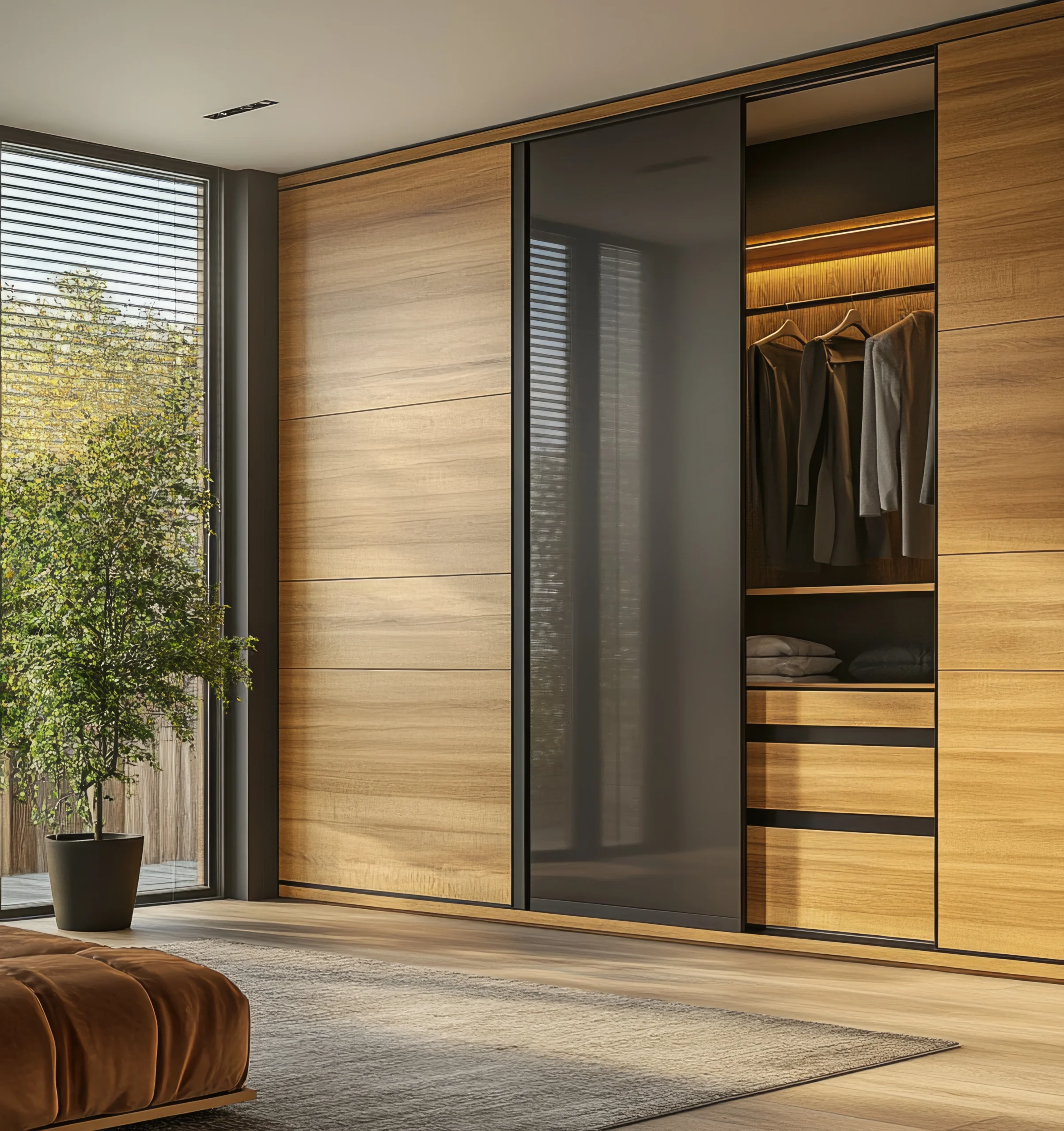
Struggling to fit proper storage into your 2BHK without making it feel boxed in? These 2BHK interior design ideas focus on fixing wardrobe mistakes that quietly destroy usable space.
Here’s the uncomfortable truth:
Most 2BHK homes don’t feel small because of the carpet area.
They feel small because wardrobes are oversized, poorly placed, and badly planned.
This guide breaks down wardrobe layouts and planning strategies that actually work in compact Indian apartments – not catalog fantasies.
These 2BHK interior design ideas prove that smart wardrobe planning – not bigger flats – can free up 15–30% usable floor space.
What matters most :
- Sliding shutters
- Controlled depth (550–600 mm)
- Floor-to-ceiling storage
- Corner utilization
- Bedroom-specific customization
Finishes and trends come last. Always.
The Hard Fact Most Homeowners Ignore
Nearly all storage problems in Indian homes come from ignoring basic 2BHK interior design ideas and copying layouts meant for larger apartments.
They come from:
- planning wardrobes after beds
- copying layouts from larger homes
- confusing super built-up area with usable space
Storage failure is rarely a space problem.
It’s a decision problem.
Why Wardrobe Design Decides Livability in a Compact 2BHK
Typical metro reality (Mumbai, Bengaluru, Pune):
- Average 2BHK carpet area: 450–750 sq ft
- Bedroom sizes: 90–110 sq ft
- Every extra inch of furniture eats circulation
Once circulation is compromised, no amount of “minimal décor” saves the room.
This is why practical 2BHK interior design ideas always start with wardrobe planning – not color palettes or décor trends.
These principles also apply to anyone aiming for a 2 bhk flat simple interior design that prioritizes function over decoration.
Carpet Area vs Super Built-Up: Where Layouts Go Wrong
Under RERA, carpet area = actual usable space.
Yet wardrobes are still planned as if:
- walls don’t exist
- circulation is optional
- bedrooms will magically stretch
The result:
- over-deep wardrobes
- bed clearances below comfort levels
- claustrophobic bedrooms with zero resale appeal
Non-Negotiable Wardrobe Planning Rules
1. Ideal Wardrobe Depth
Best: 550–600 mm
Avoid: 650–700 mm in compact bedrooms
Anything deeper kills walking space with no real storage benefit.
2. The 900 mm Circulation Rule
Minimum clear space in front of wardrobes: 900 mm
Break this and you get:
- drawer clashes
- awkward movement
- long-term frustration
3. Bed Clearance Warning
If clearance between bed and wardrobe is below 750 mm, the wardrobe is oversized. Full stop.
7 Space-Saving Wardrobe Layouts That Actually Work
The following 2BHK interior design ideas focus only on wardrobe layouts that work in real Indian apartments — not showroom fantasies.
1. Sliding Door Wardrobes
Why it works:
Eliminates door swing zones → saves 15–25% usable space
Design rules:
- Floor-to-ceiling height
- Soft-close tracks only
- Neutral laminates age better than glossy finishes
Trade-off:
Only ~60% of the wardrobe is accessible at a time.
Best for: Bedrooms under 10 ft width
2. Floor-to-Ceiling Wardrobes
Most Indian flats waste vertical space.
Smart zoning:
- 900–1800 mm → daily wear
- Top loft (450–600 mm) → seasonal items
Result:
More storage without increasing footprint.
3. L-Shaped / Corner Wardrobes
Corners are usually wasted or badly abused.
What works:
- L-shaped internals instead of deep single units
- Closed corners for kids’ rooms
- Open shelving for guest bedrooms
Best for: Square or awkward layouts
4. Wardrobes with Integrated Study or Dresser
Two functions. One footprint.
Ideal for:
- teen bedrooms
- compact master bedrooms
- guest + WFH rooms
Rule:
If furniture count reduces, circulation improves. Always.
5. Mirror-Finish Wardrobes
Psychology:
Mirrors increase perceived room size by 20–30%.
Reality check:
- fingerprints show
- scratches stand out
- frequent cleaning needed in dusty cities
Low maintenance preference? Go matte.
6. Loft-Integrated Wardrobes
Indian homes need lofts for:
- luggage
- festive décor
- seasonal bedding
Non-negotiables:
- moisture-resistant boards
- ventilation gaps
- proper load-bearing checks
Skip these and expect sagging or fungus within a year.
7. Custom-Built Wardrobes
Custom wardrobes solve:
- columns
- non-standard depths
- AC ducts and projections
Straight truth:
In small flats, custom wardrobes aren’t luxury – they’re often a necessity.
Reality Test: 10 × 10 ft Bedroom
- Queen bed: 60” × 75”
- Wardrobe depth: 600 mm max
- Required clearance: 900 mm
What works:
- sliding wardrobe
- wall-mounted dresser
What fails:
- hinged shutters
- floor-standing dressers
Dimensions beat aesthetics. Every time.
Material Selection
BWP plywood – Coastal / humid cities → Expensive, very durable
MR plywood – Dry bedrooms → Budget-friendly
Laminate – Daily wear → Scratch-resistant
Membrane – Seamless look → Heat-sensitive
Also check:
- edge-banding quality
- back-panel ventilation
These matter more than brand names.
Cost Breakdown
- Budget: ₹60k – ₹90k
- Mid-range: ₹1.1 – ₹1.6 lakh
- Premium: ₹2 lakh+
Where money actually goes:
- soft-close hardware: +₹12k–₹20k
- custom angles / columns: +10–30%
- loft integration: +₹8k–₹15k
Modular = cheaper
Custom = better fit
Choose based on layout, not showroom emotion.
10-Point Wardrobe Planning Checklist
- Depth ≤ 600 mm
- Clearance ≥ 900 mm
- Sliding for narrow rooms
- Floor-to-ceiling height
- Ventilation gaps
- AC & electrical planned first
- No hinged shutters in tight rooms
- Corner zones utilized
- Loft only with moisture-resistant boards
- Layout locked before finishes